An Interview with Dan Kerrigan
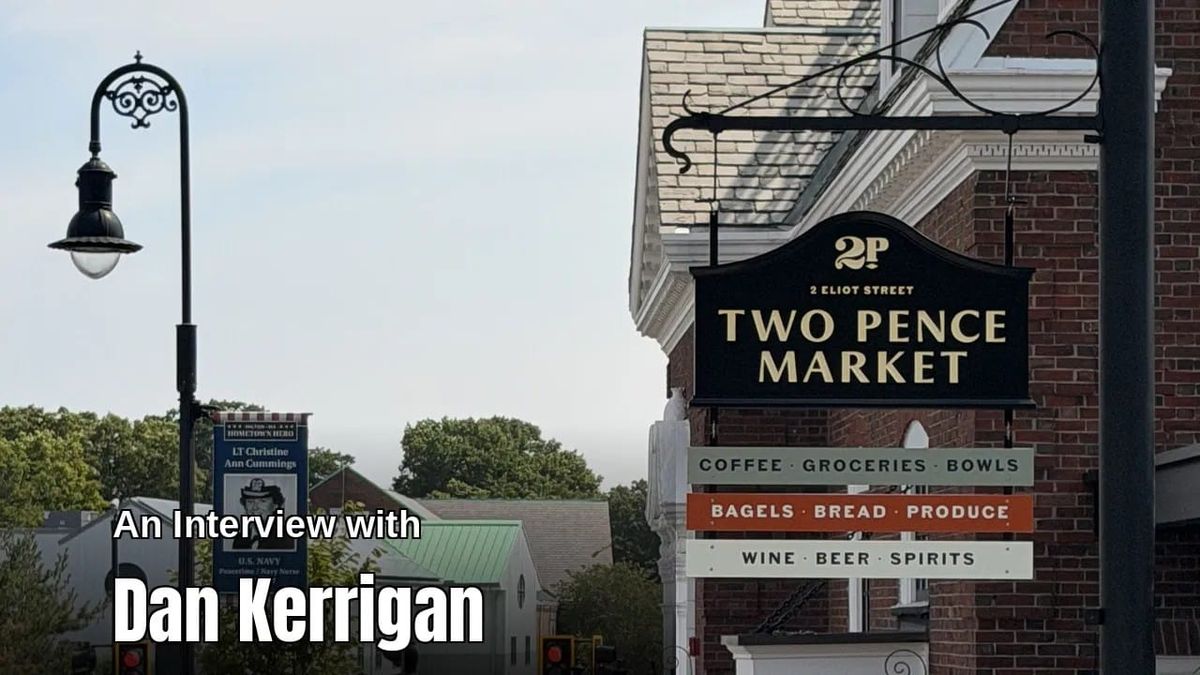
I recently sat down with Dan Kerrigan, owner and proprietor of the new Two Pence Market (and Steel & Rye, and Prairie Fire), to talk about him, his new venture, and his thoughts on building community in Milton. An AI-provided transcript follows the video.
Q: Hey everybody, this is Chris Hart with 02186 Dispatches, here with Dan Kerrigan. We're on Blue Shirt Day. How are you doing, Dan?
Kerrigan: Good. I'm glad the shirts lined up perfectly. We look like a team here.
Q: Tell us where we are.
Kerrigan: As you can see in the background, we're at the brand new Two Pence Market at 2 Eliot Street. We're sitting on the Adams Street side, on our new terrace, and excited to have a chat.
Q: Well, thanks for taking the time. We have mics clipped to us. There's a lot of traffic around us, but we ran a test, so hopefully you can hear us fine — and there will be a transcript, so for anybody who can't hear us, they can read.
Kerrigan: We'll speak up.
Q: All right, that's good. So Dan, let's start — I want to get to Two Pence, but let's start by talking about you: where you grew up, a little about your family, a little about you.
Kerrigan: Yeah, sure. I've lived in the Greater Boston area my whole life. I grew up in Reading, Mass, so, I don't know, twenty miles north of Boston.
I did not grow up in a restaurant family or in the restaurant industry. My dad is a builder — did a lot of residential construction, renovated lots of old historic homes and things like that. So I grew up working with him as a kid, weekends and summers and stuff like that. I had decided by the ripe age of fifteen that I was not going to be a builder.
Q: Sometimes when you know, you know.
Kerrigan: Yeah. So people always ask how I got into the restaurant industry, and I'd say because my dad was a builder.
Q: If he was a restaurateur, you'd be a builder.
Kerrigan: Maybe. Probably not — it's never been my best skill set. But yeah, I started working at local pizza shops and sub shops and stuff like that through high school with all my buddies, and I just loved the excitement of the industry.
Q: So you started working there, but it wasn't like you had it in mind — "hey, I really want to do this kind of thing." You started doing it and then what, you fell in love with it? How did that work?
Kerrigan: Yeah, sort of. After high school, most of my buddies had taken off and gone to college. I was attempting a community college program nearby and living at home, and quickly found out I needed to shake things up. So I went into the city, got a job working at a new bar that was opening in the financial district, and that sort of set the course for me.
I absolutely loved it. I was just intrigued by every single aspect of it. I helped the gentleman that owned it open a nightclub across the street, and eventually enrolled in a food and beverage management hospitality program at a little school in Brookline, Mass called Newbury College, which is no longer.
Q: Oh, is that right?
Kerrigan: But it treated me very well and set me on the path that I'm on today. So I'm grateful for it, for the experience.
Q: So you mentioned a couple of things. What did you find exciting about it? What were the things that really got you into it, when you were starting to realize how much you enjoyed it?
Kerrigan: I mean, at eighteen it's not hard to be excited by working in a bar. There was loud music, there were lots of people. It was never dull — you never knew what you were going to get, all kinds of characters.
But I instantly loved the idea that working together with the team, we could create experiences that people enjoyed. We could showcase new spirits to them, or put out a really excellent pizza and make their afternoon, or whatever it was. So I just knew instantly that I enjoyed spending my time in that environment.
And I worked a lot when I was that age in the restaurant industry, and ultimately ended up moving from a dingy corner bar and a late-night nightclub to more formal fine dining environments. And that really set the course for me to land in Milton eventually.
Q: I want to talk about you landing in Milton eventually, and a little about your family. But since you've opened up a few doors — there are a few threads I want to pull, if I can mix my metaphors. What were some early lessons that you learned before starting to open your own business and run your own restaurant?
Kerrigan: Yeah, it's interesting. I think all of us have heard for eons how risky the restaurant industry is, that the failure rate is really high, that it's a really difficult way to make a living. And all of those things, in a sense, are true.
But what I started to observe was that the people who owned restaurants were typically an incredibly talented chef. They're so talented that they work their way up through someone else's business, and then eventually they land their own restaurant. But the skills required to be an incredibly creative, original, risk-taking chef are sort of opposed to the skills required to be an organized, thoughtful, methodical, safe business operator.
I think the reason so many restaurants fail is that people who are really good bartenders or really great chefs are the ones who end up with their own businesses — and running a business is very different than being an employee in the industry. So that was one observation, for sure.
Fortunately for me, I was never the most creative, or the best chef, or the best bartender. But I did absolutely love orchestrating the environment, building an atmosphere, assembling a team, sharing my ethos about hospitality, about food and wine, about service, and trying to create spaces that people could enjoy.
Q: Well, let's talk about one of those spaces, because it goes back to the Milton question — Steel & Rye. That was your first venture?
Kerrigan: It's the first restaurant I owned, yep.
Q: And why did you open it up here in Milton?
Kerrigan: Sort of a multi-part answer. I'll try not to go too far back and bore you too much, but I had —
They're excited.
Q: It's an exciting intersection. It's a great place to sit and enjoy some people watching, for sure.
Kerrigan: So I had opened, in 2005, a restaurant in Westwood, Mass with a gentleman named Steve LaCount, who eventually became my father-in-law. I had been working with him at the country club over in Brookline — he was the executive chef there, and his daughter also worked there, who I was dating. And he split off to open his own restaurant. He was the chef and owner, and he was kind enough to take me in and give me a management position there. So I helped him put that restaurant together, and I worked there for about seven years as the restaurant manager or general manager, and I learned a ton.
But what was interesting about Westwood was that it had previously been a dry town. I think there were maybe one or two liquor licenses issued before he opened in '05. And what we saw was the genuine response from the community — they were so grateful to have this thing in their community, where people can stroll down the road from their house and have a thoughtfully made cocktail or a carefully picked glass of wine, and of course a meal that was made from scratch by someone who was incredibly talented and really cared about the food that was being served.
Prior to that, if we remember the '90s and 2000s, suburb dining was very different than city dining. You could go into the city and there was chef-driven, chef-run restaurants, or you could go into the suburb and there was really this mom-and-pop vibe, these sort of hokey outside-of-the-city restaurants. But you couldn't really get from-scratch, thoughtful, chef-driven cooking with carefully selected wine programs — or you didn't see it often in the suburbs.
So when we opened Chiara, it became abundantly clear that there was just such an incredible opportunity outside of the city. And working there over the years, I fell in love with the idea of becoming part of a community, getting to know the people in the community, creating a space where people in the community would actually get introduced to one another, meet each other, and then find out their kids were going to be on the same soccer team, or their children were both going to the middle school together next year. It became this sort of gathering space for the community, and when you step back and look at it, you realize it was so incredibly valuable for a town like Westwood to have something like that.
And when it became time for me — when I decided I'm going to set off and do my own thing — I was really looking specifically outside of the city limits, to find a place that felt like it could really benefit from that gathering place, that place the community can use. And Milton had also just recently at that time, this was like 2010, 2011, Milton had recently started issuing liquor licenses. So I started looking here.
Q: Well, it's funny what you're saying about gathering spaces. Two things that you said resonate. One is — and you're right — that fifteen years ago, more than that maybe, I wouldn't think about a suburban restaurant as being a destination.
Kerrigan: Right.
Q: It's just somewhere I'd go if I lived there.
Kerrigan: Exactly.
Q: Or if I was visiting somebody. But now Steel & Rye's a destination, Prairie Fire in Brookline's a destination, and I could name other restaurants. It hadn't occurred to me that that's a very recent trend that you're a part of.
Kerrigan: It really is a relatively new thing, and we stumbled upon it — not by accident. Steve, much to his credit, in opening Chiara said: this beautiful community, all of these folks are commuting into the city, working all day into the evening, commuting all the way back home, and then to go out for dinner you have to drive all the way back into the city. It makes absolutely no sense. And that area, it's an affluent community, and all of those surrounding towns, they really needed a great restaurant. I think that goes for so many communities outside of the city limits in Boston.
And Steel & Rye really has become, over the — how many years has it been now, fifteen?
Q: Fourteen, going on fifteen, yeah. Because I remember I moved to Milton not too long after Steel & Rye opened up, but—
Kerrigan: You're part of the reason we chose to open here, yeah.
Q: I was going to ask. But no, it really does feel like that community spot. There are regular Friday morning breakfast conversations, people hold political events, they'll hold birthday parties, they'll just have meetings and gatherings there. And it's a well-known destination outside of Milton, so it's been very successful in that respect.
What did you take away from Steel & Rye before opening up Prairie Fire — that was your second venture?
Kerrigan: That's correct, yeah. We opened Prairie Fire in September of 2017. I was living in Brookline at the time, and my wife and I would frequent the restaurant that was there prior to Prairie Fire, which was called Lineage.
Q: I remember Lineage. Great little spot. I like Prairie Fire more.
Kerrigan: Great little spot. We would pop down there on a Tuesday or Wednesday — both of us working in the hospitality industry — and get a dozen oysters or a glass of wine at nine o'clock at night. And when I found out that Lineage was going to close and was for sale, it made a lot of sense to sort of continue what we were doing at Steel & Rye and try to create something in Coolidge Corner that worked for the community in the same way.
But as far as lessons I learned — I think we've learned a lot at Steel & Rye over the years, and we continue to learn every day. We opened in 2012, and the first line of our mission statement is to enrich our community through great hospitality. That's just the first part of it.
And I think we were partially doing that from 2012 into 2020. I think we were creating a place to have an anniversary dinner or a birthday event or a bridal shower, a baby shower, whatever it was, and of course regular dining. But we were closed every day until 4 p.m. We were dinner only.
And with COVID, we sort of took a big step back and had a couple of quiet weeks where we weren't allowed to have staff or guests in the building. We started thinking about, if and when we come out of the backside of this thing, what do we want this to be? We reverted back to our mission and said, are we even achieving this mission? We're eight years old now — are we doing what we set out to do?
And that's where the idea for creating the bakery inside of Steel & Rye came from. We actually had been working on finding a location to build a bakery.
Q: Oh, interesting.
Kerrigan: And Brendan, our culinary director, Brendan Joy — also a Milton resident, lives here with his family, incredibly talented bread baker, as hopefully you agree.
Q: Yes, I agree.
Kerrigan: So he was really pushing this concept of building a bakery. And when we sat down during COVID, he and I sat in the empty restaurant and just started thinking a little bit harder and a little bit more focused on what are we going to be on the back side of this.
The idea to build the bakery inside of Steel & Rye completely changed the way Steel & Rye interacted with the community. It gives people an opportunity to say, yes, I want to come in and have a bottle of wine and a piece of striped bass and a nice dinner in the evening — but I can also get a cup of coffee and a croissant and work for three hours remotely, or meet up with a friend, or have a political meeting or a business meeting or a parents' meeting from one of the local schools. That felt much closer to fulfilling the mission that we had set out to do. And fortunately the community has responded to that in a big way, and it has really become that place during the day, to utilize however you see fit.
And that idea of meeting the guest where they stand — where it's like, I want to come in and grab a table and open a laptop and I might get a coffee in half an hour.
Q: Sure.
Kerrigan: The doors are open. We have a couple hundred seats between inside and outside. You can use them however you want.
So that lesson, I think, has carried through with my businesses, and certainly here at Two Pence. That's the idea of all this outdoor space when the weather's nice. We didn't have the space to do a hundred seats inside, but the idea is those seats are there to utilize however you want. If kids are riding their bikes down here to hang out with their friends, or families are walking over the hill after dinner at Steel & Rye to get an ice cream, or you just need a place to open a laptop — there is no commitment. You can just come and be in the space. And that really excites me from a community perspective.
Q: So tell me about the names. You've got Two Pence, Steel & Rye, Prairie Fire. What's behind the names?
Kerrigan: Yeah. I don't know if I'm the best at naming businesses, but Steel & Rye — I was really digging into this neighborhood and what the history of this community was when we were building Steel & Rye.
This corner where we sit, which is now so prominently known as the Baker Chocolate Factory and facility, was originally the Stoughton Grist Mill. And the Stoughton Grist Mill was the first water-powered grist mill in America. This was the place that local farmers and residents would bring their grain to have it ground into flour, and in a sense was a source of sustenance for the community and for Greater Boston.
The town quickly turned from this farming, agricultural center into a factory town. We had the Baker Chocolate Factory, the Bent Cookie Factory, the Hendries Ice Cream Factory. I think Hood had a presence here. All of these factories were all food-based as well. So in talking about this neighborhood history of food — the neighborhood history of food was both industrial and agricultural, and we used steel and rye as sort of the link to that neighborhood history.
The name also felt fitting when you walk into Steel & Rye and you have this soaring thirty-foot steel frame structure. And we're making handmade pastas and handmade doughs and pizza dough and bread. Steel and rye felt like a fitting link.
Q: So that's a great name.
Kerrigan: Thank you.
Q: That's a great name. And it fit immediately — but it's good to know the thinking behind it.
Kerrigan: Yeah. Prairie Fire was originally really this offshoot. We had built the wood-fired oven at Steel & Rye in 2015, and we really loved what was coming out of there: wood-fired pizzas, oven-roasted shellfish, tons of vegetables and grain dishes from local farms. And we decided Prairie Fire was going to be this little mini offshoot of that wood-fired ethos in the menu. So when we started putting the menu together, it was very heavy on vegetable and grain and dough-based foods cooked in fire. So Prairie Fire was sort of where we came up with that.
People have a split reaction to that name. Not everybody loves the word "fire" in the title of the business. But I think ultimately — naming a child, once it's that person's name, the personality of the business, or the personality of the child, really defines what the name becomes in the end. So Prairie Fire's worked in the long run.
And Two Pence Market — Kristen [?], my wife, named Two Pence Market. Forever a Mary Poppins fan, and "tuppence" is the British pronunciation. But this was a bank from 1929 — this had been operated as a bank, and it's 2 Eliot Street. So she named it Two Pence.
Q: That's terrific.
Kerrigan: We talked about Two Penny Market, and then Two Pence just felt a little more formal and a little more fitting of this beautiful 1920s colonial building.
Q: So tell us about your family, what you think of Milton, and what you hope for the future in the town.
Kerrigan: Yeah. We lived in Brookline for about seventeen years — Kristen [?] and myself — and our children were born when we lived there. As we started looking to purchase a new home, we knew Milton was going to be the place that we purchased a home.
It was a big decision for me, being regularly present in the dining room at Steel & Rye, to then be part of the community and be in the school system and stand on the soccer sidelines and all that stuff. But I had fallen in love with this town and the support that we received from this community for our business. So we moved here in June of 2022, and it has been the best decision. I mean, really, we know for a fact we'll live here for many years to come. We absolutely love the community.
So the idea for me of continuing to build businesses here and in the surrounding areas that are hopefully well received, and that people feel are improving the community — that's what my objective is for the years to come.
Q: That's excellent. Well, Dan, I really appreciate your time. Thanks very much. I'm excited to get to know Two Pence more and to see what you'll be bringing in the future.
Kerrigan: Awesome. Thanks for helping me to show it off. I appreciate it.
Q: Absolutely.