An Interview with Pat Latimore
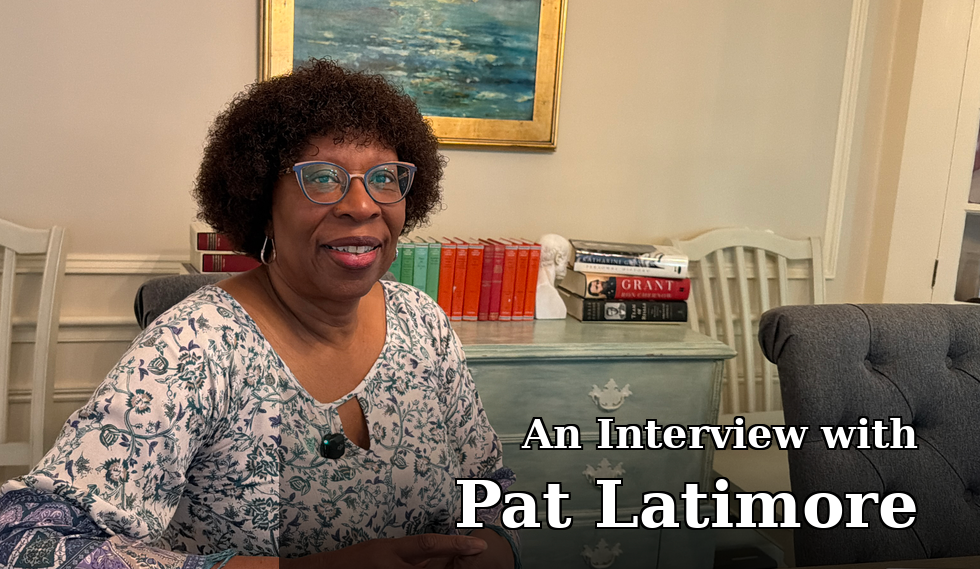
On July 8, 2026, I sat down with Pat Latimore for a discussion about her time in Milton and, in particular, her service on the town's Equity and Justice for All Committee. I appreciated (as I always do) Pat's candid insights. Below is a lightly-edited AI-generated transcript of the interview.
The following transcript has been lightly edited for clarity.
Q: Pat, good morning. Welcome to my home.
Latimore: Good morning. Thank you for having me.
Q: I appreciate you taking the time. Let's start by talking about you and your background. Tell us about where you're from, how you came to Milton — a little bit about you.
Latimore: Well, how far back do you want to go?
Q: Good question.
Latimore: I was born at a very early age. No — I'm originally from Georgia. My father was in the service, and he moved us to Massachusetts when I was in the second grade. So I've been in Massachusetts for the bulk of my life, although I did live overseas for a number of years, too.
Q: Where overseas?
Latimore: I lived in Nigeria for four years.
Q: Do you have family there?
Latimore: Yes and no. My husband was a Nigerian American, and he went to Nigeria to start up a company. I went with him, and we spent four years there, and then came back to the US. Nigeria being what it was, they had a coup.
Q: Sorry — sorry for laughing.
Latimore: No — it's easy to laugh at, but it wasn't funny. It is strange, though. I was in the US having my first son, and I got this call saying, don't come back — it's too unstable. That was in 1981. And I've been here since then, pretty much.
Q: Here in Milton?
Latimore: Not here in Milton. We originally lived in Boston — we lived in Boston until 1993 [?], and then we moved to Milton.
Q: What made you move to Milton?
Latimore: We had children, so we were looking for a place that had good schools, a level of diversity, and that wasn't too far from Boston, because we both worked in the Boston area.
Q: How many kids do you have?
Latimore: Two. Two boys.
Q: You mentioned working in the Boston area. What's your professional background?
Latimore: My professional background is that I'm a finance and operations person. I worked for a number of high-tech companies — most of them not around anymore, because that's the nature of technology. Then I worked in financial services for State Street. I was the corporate controller for State Street.
Q: Sounds like a big job.
Latimore: And then, once I finished doing the corporate thing, I decided to do some public service work. I started working with the United Way, where I eventually became their COO.
Q: How long were you with the United Way?
Latimore: Ten years.
Q: And was that your last job?
Latimore: My last job.
Q: So are you retired?
Latimore: I'm retired. Happily, happily. Really happily.
Q: What are you doing in your retirement?
Latimore: I'm on a couple of community boards, a university board, and a couple of private boards.
Q: I want to talk about one committee that you and I have both served on — the Equity and Justice for All Committee — and I'm also curious about the other boards you serve on. But first: you've been in Milton now for thirty-some-odd years. I'm curious how you've seen the town change.
Latimore: Well, when I first got here — I lived in what I guess is called West Milton, off of Blue Hills Parkway. One of the things that attracted me to Milton, as I said, was its diversity. I did not want my children to be in an environment where they were the only Black children in the area. It's certainly become more diverse — and when I say diverse, I mean diverse in a lot of ways, not just racially but also culturally. I also think it's less sleepy. It was almost the quintessential suburb of Boston. In the interim, Milton has become much more — you have more people who are active in it, who are doing different things. There was a turnover of newer people when I got here. It felt like an Irish Catholic enclave, and I would not say that as much now. There's still a base of people from thirty years ago, but it's a very different town. It's kind of opened up a little.
Q: It's interesting to hear you say that, because I've only been in the town for — oh gosh, maybe thirteen years or so. But I've noticed even in that briefer period the kind of shift I think you're talking about. It's interesting you say less sleepy, because at least in my observation, there's just a lot of activity — a lot of cultural activity, a lot of political activity. Is that part of what you're talking about?
Latimore: That's exactly what I'm talking about. You started with cultural, but I'll go to the political front first. When I came, it was the same people — in my view, there was a little club of people, small, and they kind of ran the town. Now there's a lot more diversity in that, and you could see it in all of the major elections we've had — people who have a different point of view, a much more open view of what should be happening in the town. Before, I think there were a number of people who were here doing great work, but it was traditional: my parents lived here, I live here, we want to keep it quiet and sort of in control. And now, because of what's happening not just in Milton but in the wider world, that's no longer possible. When I got here, there were basically no restaurants — a diner and a couple of pizza shops — and now there are restaurants. So it's beginning to change in that sense. And culturally, we benefit from being next to Boston, in the sense that we don't have to develop a lot of our own stuff — but you can see now that there are more things happening in town than there were before. So it has changed.
Q: The way you're describing it, it sounds like you see this largely as a positive change.
Latimore: I do. I do. It's scary for some people, because change is scary — people are afraid, and they don't know where it's going to end, or what the town is going to look like. People are afraid of new people coming in. But in general, if you look back at what it was and where it is today, it's a much more pleasant environment, in a lot of ways, for more people. So yes, I think it's more positive.
Q: You mentioned serving on boards. Before I focus you in on the Equity and Justice for All Committee — what other boards do you serve on?
Latimore: I serve on a couple of private-firm boards. I also serve on the audit committee for Olin College, which is an engineering college in Needham. And I'm on the Milton Housing Authority — that's a recent thing for me.
Q: How long have you served on the Housing Authority?
Latimore: It's recent — this past June.
Q: That's very recent.
Latimore: And I was on Celebrate Milton, which has recently closed down.
Q: That was unfortunate.
Latimore: It was. But one of the things that's interesting about Celebrate Milton is that it was started as the town was going through a lot of change — especially racially, and maybe economically too. You started to see more people who were interested in buying multi-family homes, or multigenerational homes, and that was a very scary time, I think, for the town. Celebrate Milton was formed in response to that — to make sure that people could meet each other, and to decide that diversity wasn't the most frightening thing in the world; that we actually had more in common than not. For over thirty years, Celebrate Milton tried to move that mission forward, and I think it was very successful. One of the things we as the board came to realize in the last couple of years was not that the mission had been accomplished, but that while the intent — introducing people and making people more comfortable with each other — was still important, there are a lot of organizations now that do that work: organizations like Connect Milton [?], the affinity groups in the schools, MARC — the Milton Anti-Racist Coalition. A lot of people have embraced the work, and so we felt it was time to move on and allow other organizations to take that challenge on.
The bulk of my work in town, actually, is with a group called Citizens for a Diverse Milton — CDM. We work with the public schools, helping them embrace the diversity of the children in the Milton Public Schools, making everybody feel welcome, and helping every child achieve to the best of his or her ability.
Q: How long has CDM been around?
Latimore: Close to thirty years. I was one of the founding members. And that was the other thing I liked about Milton — it's small enough that you can actually make a difference. About twenty-eight, twenty-nine years ago, a few parents got together in a living room — both white parents and Black parents — and talked about their kids' experience, and said we didn't think it was the best experience. So we started thinking about how we could make a difference. We took our discussion to the superintendent, who was Mary Grassa O'Neil [?] at that time, and we started meeting regularly to talk about what's going on in the schools. What are some of the issues? What are the things that people who have good intentions don't understand — like, what is it like to be a Black child in a public school that is ninety percent white? And then we extended it, looking at things like how boys are being treated differently — especially boys of color — around discipline. And now you look up, and it's almost thirty years later.
Q: This is all very interesting history that I wasn't aware of. One of the things that strikes me is that CDM started about thirty years ago, and some of the issues you're describing are issues that I think are still with us.
Latimore: They definitely are.
Q: I'm wondering whether you think — acknowledging that — it's also true that there has been some progress, or whether it's a little bit of running in place.
Latimore: It sometimes depends on the day. Sometimes I'm very much saying there's progress, and other times I look and say we haven't moved that far. Changing hearts and minds is work that happens over decades and lifetimes. I think the people who move to Milton, in general, want to live in a community like this, because Milton has a unique place among a lot of the towns: yes, it's a pretty high-income town, but it's also a high-income town that has a bunch of diversity in it. And I think a lot of people who move to Milton want that.
Q: I think that's right, and it's certainly something my wife and I cherish about the town. This relates directly to the Equity and Justice for All Committee. Tell me about how you got involved with the committee.
Latimore: I heard about it from a friend of mine, Karen Groce-Horan [?], the founder of Courageous Conversations [Towards Racial Justice]. Karen had talked about how we keep a dialogue going in town around race and justice, especially in the wake of the racial reckoning that had happened across the country after George Floyd. Karen told me she was going to go to the Select Board, and she had an idea: let's have a look at the policies and practices within Milton to see whether things could be improved. And the Select Board agreed. I don't exactly know how my name came up, but Mike Zullas [?] called me and asked if I would be willing to serve on the committee. And I said, yeah, I'd be willing to serve. I didn't know at the time that I was going to end up co-chairing it with you. So that was a fun thing — that was a good thing.
Q: I didn't know you before we worked together.
Latimore: No, I didn't either. And I didn't know most — I wouldn't say all — of the people who were on the committee at that point.
Q: Same here. So you co-chaired that committee in its first iteration, when it was an eighteen-month committee — it had a sunset and a specific charge to advise the Select Board, essentially as the committee saw fit. It's now in its second iteration, which you and I have both rolled off of, though we served on that as well. Tell me a little bit about how you think about the committee's work, especially in that first iteration.
Latimore: A couple of things. I think the committee did great work in that first iteration, because there was a sense of urgency — and that urgency was across the country. Everybody was trying to think about what we could do to make everyone in the country feel more included, feel safer, and enjoy all of the privileges of citizenship. So when we got together, there was a lot of energy, I would say, and we pulled together quickly a few things that we wanted to look at — knowing that we couldn't boil the ocean, that we had to be focused. The things we looked at — as you've said on your blog, actually; I don't know if this is called a blog anymore, who knows what the new technology piece is — were: the government, making sure the citizens of Milton feel like they can be a part of it and are engaged with it; youth sports, the schools, and education, ensuring we were doing as much as we could for those pieces; civil service — which we didn't do that much about, but thinking about whether the civil servants in the town, especially police and fire, represent the town in a way that we'd want it to be represented; and then, lastly, affordable housing, which was very difficult at the time, because it's a big issue. We got a lot of pushback on that piece — the 40Bs that are happening in town, and then the MBTA Communities Act, of course.
Q: When we were done, I think the MBTA piece was just starting.
Latimore: It was just starting, but all of that was in the mix — everyone worrying: if we embrace these things as a town, for affordable housing, how would that change the town? Would it start to look different than what people came to the town for? A lot of people, like myself, came to Milton because it is more suburban — that whole single-family vibe that the town has, the open space, and you're not Boston. Not to say Boston doesn't have a lot of benefits, but it also has the issues of whatever a large city is. So we were operating in that environment. But because we focused, we were able to make some very specific recommendations and complete a report — and I'm very proud of the report that we delivered to the Select Board.
In the interim, though, I think not much has been done with a lot of the work that we did, or the recommendations. That's partly the nature of politics — a lot of times, the people who help to start things in government turn over — but also maybe, from the committee's standpoint, us not being able to figure out how to make the thing sustainable. The good news was the second iteration of the committee, which is a permanent standing advisory committee of the Select Board.
Q: One thing I should say, since I have the opportunity, for all who are listening: you were a big driver — probably the main driver — of making sure that we did our work well and on time. And I have to tell you how much I appreciate that. I don't know that I ever have.
Latimore: I appreciate you saying that, but I also appreciated our partnership, because I think it was the two of us that were able to move that committee. But the committee members, too — they were dedicated. And also, having a mandate of eighteen months puts pressure on a committee to achieve something.
Q: I think that's a good observation, and there are sort of two structural issues in tension with each other at the current committee. On the one hand, you have annual town elections — constant turnover — which means the political priorities of the town are going to shift pretty rapidly, at least in my sense of it. On the other hand, you have a standing committee whose job is to advise the Select Board and other town committees, but without a specific goal and a specific end date. So how do you make sure the committee can be effective in its permanent iteration, with a series of political bodies that have shifting priorities? I certainly didn't crack that nut.
Latimore: I think that is the dilemma — the push and pull there. I do think the committee has struggled in the second iteration to find its footing: to figure out what the work is that the committee should be doing, regardless of the fact that the politics around it change. Because the politics did change. Six years later, the world — at least in the United States — has changed. That sense of urgency around diversity and equity is no longer —
Q: It's flipped.
Latimore: It pretty much has flipped. Which is very interesting, because if you think about it — how is it so fast? Maybe less so in Milton, but the urgency, I would say, is gone. So maybe people haven't flipped the script so much as they've flipped the urgency on it. And so many other things have come into play — whether it's the MBTA Communities Act, or building a new school, or whatever. It's just one of those things that hasn't risen to the top, and I think for the committee it was also difficult to keep that sense of urgency. I was a member of that committee until June, and I agree — we did not find the secret sauce for how you keep that work engaged. But I do think it's important to have some body — a consistent body — that says: what are we doing as a town, and are we ensuring that everyone is able to engage at the level of anyone else, if they so choose? And I do think that if the committee could figure out a couple of goals in the interim, it would do well.
Q: Because I think one of the things to distinguish is: the politics may have flipped, but I don't think the sense of commitment that people had has changed at all.
Latimore: I don't think so either. And as we have talked — even in the second iteration of the committee, to the Select Board, for example — I think the commitment is still there. I think the question is what the work should be right now, and whether it can be narrowed down to a focus where, maybe over a year or two, you could show progress. That's the piece, I think, that's been somewhat missing in the second iteration.
Q: Well — now that you have no responsibilities with the committee whatsoever, it's easy to ask you this question. What should the committee be doing? What's your hope for the committee's work — or maybe, to zoom out, it doesn't have to be the Equity and Justice for All Committee, but the town's work. What do you think would be, in your view, the right thing to be focusing on right now?
Latimore: I think the recommendations that the first committee made are really good recommendations. The environment has shifted, so some of them don't make as much sense as they did five or six years ago. But working to ensure participation — in government, in sports, in all the cultural activities of the town — is an important piece: for everyone to be engaged in the dialogue and feel like they have a voice.
On the government piece, I still think it's working to ensure that people get the information they need: how does the town government work, the whole governance model, how do you become engaged? One thing that I think the committee could do is help to provide that kind of information — but also to invite people in, and help the town to figure out how to engage with everybody. And it's difficult. We worked with the Partnership for a Healthy Milton [?] — in conjunction with them, we held a forum about how you bring everybody under the tent, and how you engage and communicate with citizens — with government in particular, but also with businesses.
When I first moved here, I would go to East Milton, and I wouldn't necessarily feel comfortable there. And it's not because anybody ever did anything, right? It's just that you're walking around, and you're the only person of color that you see. Now you walk around there, and — that's the progress piece — you do see a lot more people of color. And so, I think by definition, you feel more comfortable. That's just one thing, and I think the town needs to understand how we do those types of things — and I think the committee can help with that.
Some of it is just basic information: how do you volunteer, for example, with the various committee structures in town? Because although I think the form of town government is great, most people have no idea what it is. If you're coming from Boston — or, God forbid, out of state —
Q: Georgia or California, let's say.
Latimore: — what is this town meeting thing, and how do you get involved? Because it feels like it's just a little club. And it's not — but it can feel that way. And everybody doesn't have the same availability or flexibility to participate in everything. But you want to give people the information to say: maybe you want to be a Town Meeting member — how do you go about doing that? You want to serve on a committee — who's responsible for nominating, or vetting, or approving people for the committee? You asked me how I got involved with the Equity and Justice for All Committee — I would assume it was through word of mouth.
Q: Right. Somebody knew — Mike knew — to call you.
Latimore: Mike knew to call me because somebody said, call Pat. But what about the people who are new to town, or who have been in town but don't know somebody who knows one of the Select Board members? How do you ensure that they know what all the opportunities are? Those are the types of things I think the committee could be doing.
I also think — people in town talk about the lack of civility in town, in terms of our civil discourse, and I think we could be a part of helping people to engage. I don't know what that looks like, but it could be just having small conversations and working with other groups. That's what I think we did with the Partnership for a Healthy Milton: we said to ourselves as a committee, here's a group that's willing to do a lot of the logistical organization work, and why shouldn't we help them have a conversation about how the institutional structures in town engage and communicate with the people that they're here to serve? And we helped to put on the forum. So I think those are the types of opportunities we should be looking for.
And then, lastly, I think there are a lot of issues that the town is in discussion about, and they are all equity issues — whether it's affordable housing, or what the vision for the town looks like as we move forward. That's something every citizen — not just citizens who are newer, or people of color, but all of us — has a stake in. So I think maybe the committee could help to have dialogues about the future of the town, and who makes those decisions, and how the average person can influence them. Because I don't think it's obvious.
Q: No, I don't think so either. Are you optimistic?
Latimore: I am, because the one thing I like about Milton is that — I think because it's a smallish town — it encourages people to participate. I don't think it encourages everybody to participate, but I like the fact that so many people run for Town Meeting. I'm always surprised — I'm like, "Wow, you're going to run for Town Meeting? That's going to be a commitment." But people do. And I work with the schools, and there are so many people who give so many hours of their time — whether it's working on PTOs or various school committees, or just volunteering in their child's classroom. Milton is a really active community around things like that. And so, to me, that gives me cause to say people care. People care.
Q: I think that's a good place to end. Pat, thank you very much for your time. I really appreciate your time and your insights.
Latimore: Thank you. Thank you much — I enjoyed this.