An Interview with Ben Zoll
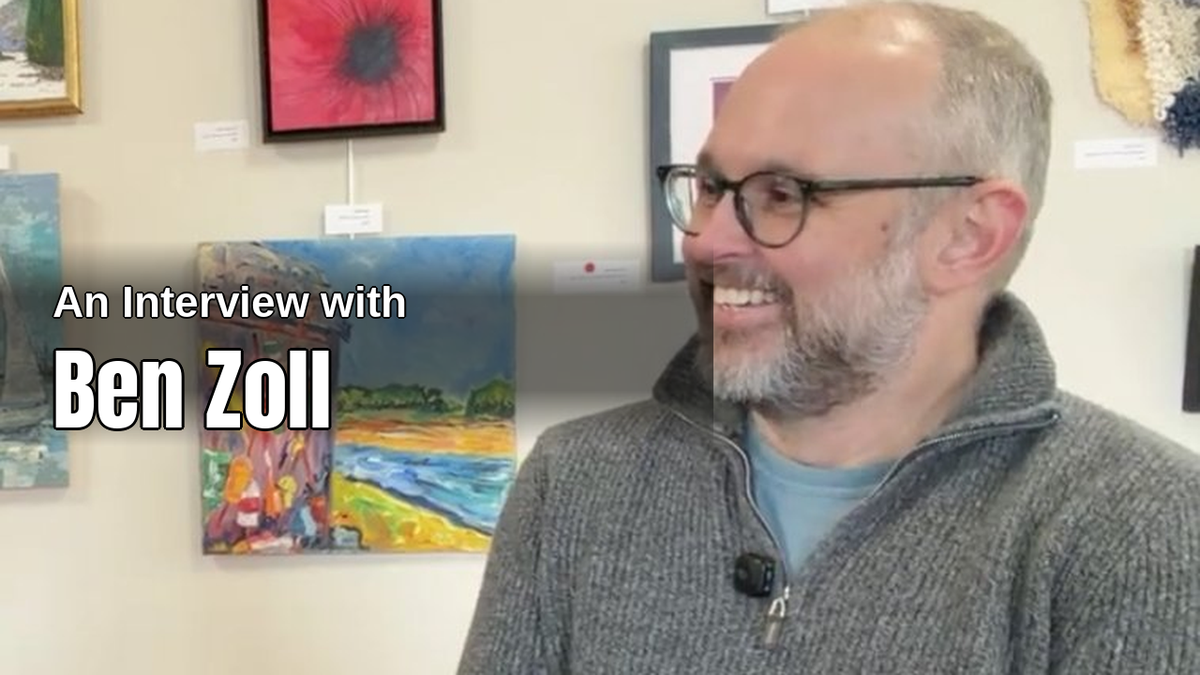
I interviewed Ben Zoll, Select Board Chair in 2025-26, who recently ended his term. We discussed what he learned during his time on the Board, and what he hopes for Milton going forward. The video is below, and an AI-generated transcript follows.
Editor's Note: Pardon the production quality. As the site grows, I hope to improve the quality of the interviews. Thanks to Ben both for his time and for his patience.
Recorded on a Friday morning at the Milton Art Center. Lightly edited for readability; meaning unchanged. Names marked [?] could not be verified against the recording.
Q: So I'm here with Ben Zoll. Thanks, Ben, very much for joining us. We're here at the Milton Art Center on a Friday morning. Thanks for taking the time.
Zoll: My pleasure.
Q: So Ben, you're my first interviewee in what I'm calling 02186 Dispatches, which is a community website. The idea behind it is just that — to help build community. And I thought, who better to start with than the former chair of the Select Board, who just rolled off and is going back to civilian life — so we can learn a little about you personally, but also what you learned on the Select Board.
Zoll: Sounds like a good idea.
Q: Great. And my apologies to everybody in advance for all the things that are going to go wrong in this first interview. Please forgive me — it'll all improve as time goes on.
Zoll: You're setting the bar low.
Q: Well, the one thing that went well is that I picked a good first interviewee — so nobody can blame me for that. So, Ben, tell us about you. Tell us a little about your background, how long you've been in Milton, your family life, all that.
Zoll: Sure. I'm from Toledo, Ohio originally — born and raised there. Then I went to college in upstate New York, Hamilton College, where I happened to make several friends from the Boston area. Then I spent a period of time moving around, living abroad — in Taiwan, going to grad school in Seattle, Washington, then living in Washington, D.C., and then Singapore. Ultimately I decided to move to the Boston area. I was offered a position at Harvard, and I did some research.
The two factors that brought me to Milton were the school system — I really wanted to be in a school system where my kids would have the opportunity to do a language-immersion program, which was something they'd been doing in Singapore with Mandarin. French is obviously not Mandarin, but I figured it would be a useful tool. And the second reason, honestly, is the trolley. I was going to be working at Harvard, and I felt like it would be nice if I could take a train to work instead of having to brave the Boston traffic. That was in 2012, so I've been here now 14 years, I guess.
Q: What do you like about Milton? What's your favorite thing now that you're here?
Zoll: It's hard to say. The people, probably, number one — I've made some of the best friends I've had my whole life here in this town. I love the community. My kids have gone through the school system and had a great experience. And frankly, I love the Blue Hills — I love walking around out there. I love the burgeoning restaurant scene; I really enjoy walking into Novara or Steel & Rye, seeing people I know, and having a great meal. So there's a whole lot to like. And the music scene, I should add, is really fabulous.
Q: Tell me about your music background, because I've been a witness to your participation in the music scene — yours and Jen's. You should tell a little about Jen.
Zoll: Yes, thank you. So — my dad actually went to school for music. His dad was a band conductor and a music professional. So I had a lot of pressure on me when I was a kid to be playing classical music and instruments, and I was not that into it. But I picked up my dad's guitar and started to teach myself, and ended up joining a band in high school where I played bass. I was in a band in college, and then my wife Jen and I started playing music together. One of our first performances, I think, was the Glover [School] PTO event — Giddy Up Glover. And then we've been playing Porchfest. We play here on the regular. It's really amazing. Jen is actually in another band that's mostly — maybe all — Milton residents at this point. So there's a really great group of individuals here who love to play music. They play together, we swap parts around, and have a good time. The culture is really one of support. People come out for each other, and it doesn't matter what the genre is — people will show up and support you. So it's a really fabulous part of the Milton experience.
Q: I've seen you and Jen play — when you got married, at Porchfest, at other venues — and it's clear you guys have a good time. It's fun to watch. What's the name of your band?
Zoll: We're Owl House. It's House like Haus.
Q: Okay, like the German.
Zoll: Yes. And her other band is Mini Split.
Q: Mini Split, that's right. What do you do professionally?
Zoll: I'm a fundraiser. I work for the Yale School of Public Health. I've worked for a number of different institutions where I find resources that are needed for academic research or students. I've worked at Boston Children's and Harvard, as I mentioned, also Brown in the area. It's a really rewarding career, in that I get to meet some incredible people doing amazing things, and then try to find other folks who will come in and support them.
Q: And how long have you been at Yale?
Zoll: Almost three years now.
Q: And where were you before Yale?
Zoll: I was at Brown.
Q: What have you found different or unique — I know we're also in a different political environment — about being at Yale than your previous work?
Zoll: Well, all of that work has changed dramatically over the last couple of years. I know from my former colleagues at other institutions that everyone's suffering from the same cuts in federal funding to research — that are not done with a scalpel. They're done with not even a butcher's knife; it's kind of like a rusty chainsaw. And that's undoing years and years of work and impacting future generations.
So what's changed in the last couple of years is the urgency of helping institutions figure out how to diversify where their resources are coming from. Having an explicitly federally funded research model is probably not great for any institution, just because you never want to have all your eggs in one basket. So there's been an increased sense of urgency in figuring out how to diversify, and also — in particular, research on things like LGBTQ health and racial equity has been really impacted. Those are issues that I care very much about.
Q: To switch to something a little more light — I know two other things about you. One is that you like to play soccer, and the other is that you like board games. Can you talk about those?
Zoll: Yes. That's another great example of Milton community. I've loved soccer for a long time, but I never played it in high school or college. About 10 years ago, some of the friends I'd made here invited me to join this pickup soccer group, which we lovingly call hack soccer. There are two rules. The first rule is that you can only curse at yourself — you can curse as much as you want, but it can only be directed at yourself. And the second rule is that everybody has to work tomorrow, because we usually play on Mondays. So no sliding into tackles, nothing crazy.
It's an incredible group of people. We're not all Milton — we've got some folks who come from Quincy, from Dedham [?], and from Hyde Park — but for the most part they're coming in from Milton. We range in age from, I think our oldest player now is probably in his mid-70s, and our youngest is younger than me, so it's hard to keep track — probably in their 20s or 30s. We have a good time together. It's as much a social occasion as it is exercise — we play for a good hour and a half, and then we go to the Hillside Tavern in Canton and undo all the good we've done for our bodies.
Q: One question — who's the best flopper?
Zoll: Oh, nobody ever really dives into challenges. Nobody really wants to fall over. We complain a lot, but I think we'd probably do more damage to ourselves flopping than we would actually playing.
Q: Point well taken. And on the board-game side?
Zoll: I can't remember how I got looped into board games, but it must be 10 or 15 years now too. I just find them fascinating. A lot of us grew up with games like Monopoly and Clue, where it was a lot of luck, a little strategy — basic game-theory stuff. And there's this whole world that was opened to me of interesting games, cooperative games, which I really love, where you're trying to play together with your friends to beat the system rather than trying to beat each other. The themes are a lot of fun. I play a 1920s-themed H.P. Lovecraft game, which I think we played —
Q: Yeah.
Zoll: Which is a lot of fun. And I play a game where you're a jeweler in medieval Venice and you're trying to attract the nobility to your jewelry store. So there are all sorts of fun and interesting stories you can get into. And for me, it's a lot nicer to sit down with somebody and play a game for an hour than to watch a television show for an hour.
Q: It's a social enterprise.
Zoll: It's social, it's engaging. I have to work pretty hard to keep the competitive side of myself down.
Q: I've seen that, too.
Zoll: Yes. But if you can keep it all in good fun, it really is a lot of fun.
Q: Well, I don't have to [keep it in good fun] when I play with you, which has only been a few times, because you usually beat me. So I know that going in.
So, I know you just rolled off the Select Board. You served one three-year term, and your last year was as chair. I'm curious about a few things. If you can take yourself back — why did you decide to run in the first place?
Zoll: Well, I ran because people asked me to, actually. I had been on Town Meeting and obviously do a lot of stuff around town. I didn't think I was particularly a natural Select Board candidate, because I hadn't done the traditional route — which is that you serve on Town Meeting for 20 years and on the warrant committee for 10 years, and then you might be ready. I'd served on Town Meeting like two terms.
Q: Has anybody followed that model anytime [recently]?
Zoll: Not recently, I don't think. But I ran because people asked me to — and not just because they asked me to, but then we talked about the issues that were coming up to face the town, and I felt like I could make a difference. So I decided to throw my hat in the ring. Relatively unknown on the Milton political scene, but I had a lot of friends around town from the different things I was in, and I think that probably helped in terms of getting elected.
Q: So, if you could narrow it down to one or two things — what do you think were the biggest lessons you took from your time on the Select Board?
Zoll: That's a great question. My first takeaway would probably be that it can feel — particularly if you're on Facebook — that there are so many things that divide us as a town, and in actuality most people who live here agree on about 90% of things, I would say. We all want our kids to go to good schools. We all want the police and fire departments to have the equipment they need. We want to take care of our seniors. We want our roads to be better and safer, with fewer cars on them. I think we can lose sight of that when we get into some of the specifics on solutions. But ultimately we have a lot more in common than not.
My second big takeaway is that the role local government plays in impacting your life is extraordinary, in ways a lot of folks don't understand — and maybe they're starting to get it. We talked earlier about the national political scene and how that impacts folks, and that's not to downplay it. But really, your local government determines what kind of town or city you live in. And I think people just don't pay attention enough to it — and they really ought to. Not because of what somebody put on Facebook, but they ought to tune into a meeting or two. They ought to listen. They ought to ask questions of their elected representatives. I loved getting questions from constituents — it was a whole hodgepodge of different issues that I'd get asked, and sometimes I didn't know the answer. Most of the time I didn't know the answer, and so helping them figure out their problem was a learning lesson for me too.
Q: Was that the thing that surprised you the most during your service, or were there other things that surprised you?
Zoll: I think the thing that surprised me the most in a positive way is how much importance the Select Board and Town Meeting play in the way we live our lives here. The thing that surprised me in the opposite direction was how quickly people are willing to just forget that you're a neighbor — particularly when they're online, but not exclusively — and make the strangest and kind of gross assumptions about who you are, why you're doing what you're doing, why you live in town. That surprised me. I kind of expect that stuff at the national level, where I'm not going to run into Donald Trump — and I feel like if I did, I probably would say the things I say online to his face. But I would see folks in the Fruit Center who had called me terrible things on Facebook, and I think they knew who I was and I knew who they were, and I just don't see how that makes the world a better place.
Q: So that's a natural segue to something I'm very interested in. Now that you've served on the Select Board and you're no longer on it — what do you think is underappreciated, or what challenges are underappreciated, that the town is currently facing? I ask it that way because there are things we all know — they're in the Milton Times, we talk about them a lot. MBTA Communities was one. Building a new school is one. There are issues that crop up every year or so that dominate the headlines. But you're right — sitting in Select Board meetings, the vast majority of the work you do is very collegial. It's almost like the Supreme Court decides most things 9–0, not 5–4. But as a result, not everybody really knows all the challenges facing the town. So, putting that hat on — what is it you really want people to understand that maybe flies under the radar?
Zoll: Well, I don't know that this flies under the radar so much, because at the last Town Meeting the warrant committee chair, Jay Funding [?], made a presentation about this, which then was not discussed for the rest of the meeting. But I think folks ought to really understand what a precarious financial situation we're in as a town — our extreme reliance on residential taxes to fund our services, which is capped by law by Proposition 2½, and is never going to keep up with inflation.
You just have to fill up your car today — although I drive an electric, and I have to say I'm very grateful for that right now — to see how inflation does not grow at 2½%, and costs don't rise that way. When we talk about our town employees and their healthcare, everybody kind of knows from their own work that healthcare costs are growing at higher than 2½% per year. But we have to apply that to the town.
So some folks in this town have maintained this belief that if we close our eyes and close our ears, we'll be able to be the same town we were in the 1980s, or the 1950s, or the 1890s. And that's just not true. I don't think folks have really thought about how we as a town are going to adjust to this picture, because we really have three choices.
We can choose to diversify our tax base — finding more opportunities for commercial taxes, other sources of taxable income — in order to counterbalance Prop 2½ and let our budgets grow at a more natural rate. We can accept the fact that we're going to have to have an override every three to five years to keep up with inflation, which is just going to drive taxes higher and higher, which I don't think anybody particularly wants. Or we decide that we don't want overrides and we don't want to diversify, which is going to mean a significant deterioration in town services.
Those are our three options. There's not a magical fourth bullet where we get to keep taxes low, have no growth, and keep the services we have. So I think ultimately we need to have a reckoning as a town about this situation, and come up with a significant plan to address it. That's what's really missing right now. We do have the master plan, but I don't feel like people have really appreciated how dire our financial circumstances are.
And they're not dire because teachers are wasting money. They're not dire because the town is wasting money. They're certainly not dire because people in elected roles are making money behind people's backs. They're dire because this is the system of government that exists in Massachusetts, and because of the federal pressures. We can choose a different fate. We don't have to be resigned to deteriorating services or soaring taxes — but we have to choose. Not choosing is a choice. If we choose not to address it, then we're basically opting for number two or number three — the consistent overrides, or the deterioration.
Q: Is the Select Board the body that really has to be in leadership on resolving these issues? Part of the reason I ask is that I love the New England political system. I love Town Meeting. I know it can be frustrating, but democracy can be frustrating for various reasons. Town Meeting, I think, is wonderful. But one of the both features and bugs of that system is that elections are annual. It's good that we're constantly debating, but it does mean — at least from my perspective as an outsider — the momentum can be stalled, depending on the makeup of the Select Board in a given year. So I'm wondering: does this really best sit with the Select Board, or is there another way you think would be the best path forward on these issues?
Zoll: It's a great question. I agree with you, first of all, on the extraordinary nature of Town Meeting. We're very lucky to live in an environment with one of the oldest, if not the oldest, forms of democracy — if we don't count Native American forms of democracy, which of course existed long before we were here, but certainly in terms of Western European democracies. It's a great system, and as Winston Churchill said, democracy is the worst form of government except for all the others. So we have a system that's going to have its flaws.
Annual elections — people are starting to feel they're a little onerous. It used to be that maybe your best friend was running for a planning board, so you put their sign up in your yard. Now it feels like you have to have everybody's sign up in your yard, or nobody's sign up in your yard. It just feels like a lot to pay attention to. I don't know that there's an easy resolution to that.
In terms of momentum and direction, I do think the advantage of the Select Board now, with the five-member system, is that in any given year — barring resignations or anything extraordinary — you're only going to have two-person turnover. So if things are going relatively well, you may not have turnover, or if you do — in a case like me, where you step down — the folks who end up replacing you are relatively aligned. I don't think anybody's ever 100% aligned with anybody, but relatively aligned on visions for the town.
So I do think ultimately the Select Board is the executive body for the town, and it makes sense for it to be the leader in that space — but you have to lead as first among equals. You need the buy-in of other committees. In particular, Milton has done a great job of creating a strong town-administrator system, which helps provide a through-current for whatever change might be happening. We have a great town administrator in Nick Milano, and I've seen him work with people from all different walks of life and all different political stripes — he is consistent and warm and transparent in how he works with everyone.
So the answer to your question is yes, I think the Select Board is the right group to try to create that vision — but it does need to be created with the buy-in of other groups. And when you really come to loggerheads, like the MBTA Communities issue you alluded to earlier, it doesn't help the town when you have extraordinarily big chasms in terms of what people feel is possible or not possible. Looking back on that stretch of time here in town, I don't know if there was a way around it. You look at Marblehead and some of the other towns in Massachusetts today that are still wrestling with these problems, still losing state funding or coming under the microscope.
People have forgotten that MBTA Communities was a bipartisan bill, signed by Charlie Baker. It was not viewed as a particularly contentious piece of legislation when it was passed. The contentiousness has been generated at the grassroots level, and I understand the fear that people have. So it's tough. This is where I think people need to be paying attention to what's going on at the local level — because if folks had been [paying attention], with the number of open-house sort of situations that the Select Board, planning board, and town put on to help people understand what the MBTA Communities Act was, why it was in place, and what it would mean for the town — they tried their best to get folks to pay attention, but ultimately, not to put the blame on Mark Zuckerberg again, people can do the best, most consistent efforts and have them undone in a moment with a couple of keystrokes on a website, whether they're grounded in reality or not.
I think folks, if they spent the same amount of time watching planning board or Select Board meetings as they did scrolling on Facebook, would be much more informed about what's going on in town. They may not necessarily agree with what they're hearing, but they would at least hear what the arguments were — and hopefully arguments grounded relatively in reality.
Q: Well, you anticipated the last question I wanted to ask you — and it's also the reason we're talking. You and I have talked about this. I think you and I recognize, and I know others recognize, that it's sort of the same phenomenon that's been driving a lot of people to run for office, which is a great thing. But it's the feeling of, number one, wanting to do something, and number two, feeling compelled through the ordinary contention that happens in democracy. And that's very healthy disagreement —
Zoll: Absolutely.
Q: Well-felt disagreement is always very healthy. But what's not is a lot of the toxicity we see encouraged by social media. So I guess I wonder — maybe there's no magic elixir — but what is a way forward in terms of making this town's discourse healthier?
Zoll: That is the million-dollar question, isn't it? I think the way forward is really things like this. It's two people sitting down and talking to each other. It's people getting together in person, having conversations, sharing their ideas, hearing other people's ideas, challenging them in ways that are friendly but honest and earnest, and ultimately coming to compromise.
I think folks have really gotten to the point where they feel like it has to be 100% the way I see it, or it shouldn't happen at all. And you don't live your life like that at home, right? You don't live like that with your spouse — "either you cook dinner tonight or I'm setting the house on fire."
Q: You heard my conversation last night.
Zoll: "Either you pick up your laundry or you're getting kicked out of the house." We compromise. We understand that people have flaws. We understand that some people are good at some things and not so good at others, and may have the right ideas but the wrong intentions, or the right intentions but the wrong ideas — and figuring out how to parse that can never be done on social media. It's too complicated. It requires interaction and engagement in a way that I think this country was founded on. Our nation was founded on the idea that people should be able to get into a room, disagree about something, and then come out with a solution. The founding fathers did not envision a country where everybody elected to Congress would agree about everything — but they created a system where Congress would do things. The same is true with local government. I know from personal experience that there aren't 100% of the issues where everybody on the Select Board agrees on everything.
But when we're at our best, we come together with an understanding of what the problem is, and an understanding that everyone around the table has the town's best interests at heart — even if you may disagree about what that best interest is. By working together, having conversations, consulting with experts, and listening to residents who are impacted — whether they're next door to something or on the other side of town — the Select Board, whichever board it is, should be able to come up with something that resembles a solution. And if they can't, then we're at a real problem. If the solution is that we're not going to do anything about the challenges we face as a town — we kind of know what that looks like. It looks like worsening roads. It looks like crowded schools. It looks like terrible traffic.
I look at things like the Randolph Avenue road diet we put in place on [Route] 28 as a great example of what happens when we listen to each other. I remember where I was — I was sitting at Trillium outside with a friend from Weymouth, and I got a notice on my phone that there had been a terrible accident on Randolph Avenue. I'm not one of the people who's going to go rubberneck an accident, but I'm texting with the town administrator, texting with the chief of police. It was clear there was at least one fatality. And we knew this was a dangerous road — we'd been talking about Randolph Avenue in this town for years and years. So last summer, when this happened and I was chair, I thought, this is an opportunity for us to really do something about it.
We knew we weren't going to be able to build a highway or a subway or a dedicated bus line, but we could talk to the state, figure out what resources they were willing to put in — because it's a state road — have a design, invite residents to hear the design, put the design in place as a pilot, hear from residents about what's working and what's not, and tweak it around the edges so that people coming through, seeing a lot of cut-through traffic, we can figure out how to cut that down. But ultimately we had to do something. Not doing something was not an option, because we were literally losing lives on that road.
Was everybody happy with the road diet? No. Does it still need a little bit of tweaks? Yeah, it definitely does. But that's what democracy looks like. You try to come up with a solution that's going to be a little imperfect, but it's at least an attempt at getting things started. And then, if the democratic process works well, you continue to refine that solution — and at the same time think about other things, like how we can get people driving less, or how we can offer alternative modes of transportation.
That's what democracy looks like. People forget, when they're on a street like Randolph Avenue — maybe stuck in traffic, maybe sliding through, maybe it's safe — that this was not done because somebody snapped their fingers and put it down there. That was the result of a lot of meetings, conversations, expert advice and guidance, and consultations with neighbors. That's what success looks like. It's not sexy. It doesn't appear overnight. But when government is working at its best, that's what it looks like.
Q: That seems like a great place to end. Ben, I really appreciate your time. Thank you very much. And thank you all for watching.
Zoll: Thank you.